
Part 3 of the Nauman Strategic Partners SMA Manager Due Diligence Framework
Over the past two weeks, we’ve explored the first two Ps of the Nauman Strategic Partners SMA Manager Due Diligence Framework: Philosophy and People.
First, we examined what an investment manager believes and whether those beliefs are reflected in the portfolio.
Next, we looked at the people responsible for making investment decisions and why advisors need to understand who is actually managing their clients’ money.
This week, we move to the third P:
Process.
Learn more about Nauman Strategic Partner’s SMA due diligence framework here.
A manager can have a compelling investment philosophy and an experienced team. But without a disciplined and repeatable process for turning those beliefs into actual investment decisions, neither means very much.
A philosophy explains what a manager believes. The process demonstrates how those beliefs become a portfolio.
And for financial advisors conducting SMA manager due diligence, understanding that process is critical.
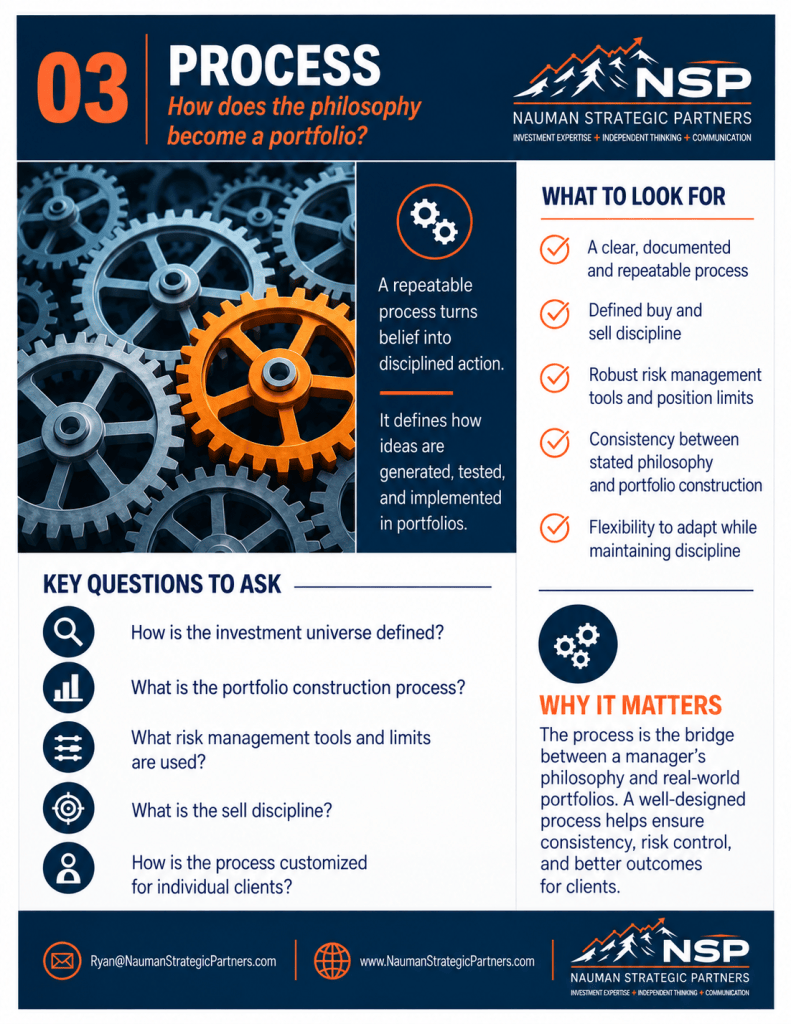
Why Process Matters
Every investment manager has a story about how they invest.
Some emphasize fundamental research. Others focus on quantitative models, valuation, macroeconomic trends, or identifying market inefficiencies.
But describing an investment philosophy is different from explaining how that philosophy is implemented.
How does the manager identify potential investments? What determines whether a security makes it into the portfolio? How are position sizes established? What happens when an investment thesis changes?
And perhaps most importantly, what causes the manager to sell?
These aren’t minor details.
They determine how a portfolio is constructed, how much risk it takes, and how it responds when markets become challenging.
A well-defined investment process should help remove emotion from decision-making, promote consistency, and ensure that portfolio decisions remain aligned with the manager’s stated philosophy.
That doesn’t mean every investment decision will be correct.
But it should mean that decisions are made within a disciplined framework rather than in reaction to the latest market headline.
Key Questions to Ask
When evaluating an SMA manager’s investment process, I would start with several questions:
- How is the investment universe defined? What makes a security eligible for consideration?
- How are investment ideas generated and evaluated? Is the process primarily fundamental, quantitative, technical, or some combination?
- How is the portfolio constructed? What determines security selection, position sizing, and diversification?
- What risk management tools and limits are used? Are there defined guidelines for sector exposure, individual holdings, and portfolio concentration?
- What is the sell discipline? What specific conditions would cause the manager to reduce or eliminate a position?
- How much discretion does the portfolio manager have? Is the process systematic, discretionary, or a combination?
- How are investment decisions documented and reviewed?
- How does the manager accommodate client-specific restrictions, tax considerations, and customization?
That last question is particularly important when evaluating separately managed accounts.
One of the primary attractions of SMAs is their ability to provide a degree of customization that traditional pooled investment vehicles generally cannot.
But advisors should understand how that customization is actually implemented—and whether it changes the strategy’s intended risk and return characteristics.
What to Look For
I want to see a process that is clear, disciplined, repeatable, and consistent with the manager’s philosophy.
That doesn’t mean every manager needs to follow the same approach.
A fundamentally driven stock picker will have a very different investment process than a quantitative manager.
And that’s fine.
What matters is whether the manager can clearly explain how investment ideas move from initial research to an actual portfolio position.
There should be a logical connection between the stated philosophy, the research process, security selection, portfolio construction, and risk management.
I would also pay particular attention to sell discipline.
Managers often spend considerable time explaining why they purchase securities.
But knowing when and why they sell can be just as important.
Does the manager sell when a valuation target is reached? When fundamentals deteriorate? When a better opportunity emerges? Or when a position exceeds its risk limits?
An advisor should understand what triggers those decisions before the strategy experiences a difficult market environment.
Another important consideration is consistency.
Does the manager follow the same decision-making framework when markets are favorable and when they’re not?
A disciplined process should provide structure during both periods.
The SMA Customization Question
This is one area where I believe advisors should spend additional time during due diligence.
SMAs are frequently marketed around their ability to accommodate individual client needs, including tax management, security restrictions, concentrated positions, and other preferences.
Those capabilities can be valuable.
But customization also introduces additional complexity.
For example, what happens when a client restricts ownership of several securities that would otherwise represent meaningful positions in the manager’s portfolio?
Does the manager have a systematic approach for finding suitable replacements?
How are tracking error and unintended portfolio exposures monitored?
What happens when tax-loss harvesting opportunities conflict with the manager’s preferred holdings?
Customization should be an extension of a disciplined investment process—not an excuse to abandon it.
Advisors should understand how much flexibility the manager has and whether the firm possesses the resources and technology to implement customization consistently across client accounts.
Red Flags: When the Process Doesn’t Match the Story
As with Philosophy and People, one of the biggest warning signs is inconsistency.
A manager may describe a highly disciplined investment approach, but the actual portfolio decisions should support that description.
Some red flags I’d investigate include:
- An unclear or inconsistent sell discipline. The manager can explain why securities are purchased but struggles to articulate when they should be sold.
- Portfolio holdings that don’t reflect the stated philosophy. The investment process sounds compelling, but the resulting portfolio tells a different story.
- Frequent changes in the investment process. The manager appears to adjust their methodology primarily in response to recent market performance or popular investment trends.
- Weak risk management controls. Position sizes, sector exposures, or portfolio concentration appear inconsistent with the strategy’s stated objectives.
- Excessive reliance on individual judgment. The manager claims to follow a repeatable process, but investment decisions depend heavily on the instincts of one individual without clearly defined guidelines.
- Limited documentation or accountability. The manager cannot adequately explain how investment decisions were made or evaluated.
- Customization that compromises portfolio discipline. Client restrictions or tax-management decisions introduce unintended risks that aren’t properly monitored.
None of these observations automatically makes a manager unsuitable.
But they should lead to additional questions.
For example, an investment process may legitimately evolve as new technology, research capabilities, or market conditions emerge.
That’s not necessarily a problem.
The important question is whether those changes represent thoughtful improvements to the process or a reaction to recent underperformance.
A disciplined process can evolve without losing its identity.
The Real Test Comes When Markets Get Difficult
It’s relatively easy for an investment process to look effective when markets are moving in the manager’s favor.
The more revealing periods often occur when the strategy’s investment style falls out of favor or when markets experience significant volatility.
That’s when advisors can gain valuable insight into how the manager actually makes decisions.
Did the manager follow established risk controls?
Were portfolio changes consistent with the stated investment philosophy?
Did the manager maintain discipline, or did the process change in an attempt to keep pace with the market?
And perhaps most importantly, can the manager explain the decisions that were made, even when the outcomes weren’t favorable?
A good investment process doesn’t guarantee good performance. But it should make investment decisions understandable, consistent, and accountable.
That’s an important distinction.
The Process Test
For me, the third P ultimately comes down to one question:
Can the manager clearly demonstrate how their investment philosophy becomes a portfolio through a disciplined and repeatable decision-making process?
I want to understand how ideas are generated.
How securities are evaluated and selected.
How portfolios are constructed.
How risk is managed.
What triggers a sell decision.
And how the process accommodates individual client needs without compromising the strategy’s integrity.
The answers should connect directly to the first two Ps.
The Philosophy establishes what the manager believes.
The People are responsible for making the decisions.
And the Process determines how those beliefs and decisions are translated into actual client portfolios.
Because a great investment story is only the beginning.
What matters is having a disciplined process for putting that story into practice.
That’s why Process is the third P in the Nauman Strategic Partners SMA Manager Due Diligence Framework.
Next in the series: Performance — Does the evidence support the story?


Leave a Reply