
The Nauman Strategic Partners SMA Due Diligence Framework
Beyond performance. Beyond the fact sheet. Beyond the manager’s story.
A practical framework for helping financial advisors evaluate whether an SMA manager’s Philosophy, People, Process, Performance, and Platform align with the client’s objectives, constraints, and risk.
Why SMA Due Diligence Is Different
SMAs offer advisors something that traditional investment vehicles often cannot: greater personalization.
Depending on the strategy, advisors may be able to incorporate tax management, individual security selection, values-based restrictions, concentrated positions, charitable giving strategies, and other client-specific requirements.
That flexibility is one of the biggest advantages of an SMA.
But it also creates additional due-diligence questions.
The advisor isn’t simply selecting an investment product.
They are selecting an investment process and a partner that will be responsible for managing an individual client’s portfolio.
That means looking beyond the fact sheet and asking deeper questions about the manager, the investment team, the portfolio construction process, the firm’s capabilities, and the actual client experience.
The 5 Ps of SMA Manager Due Diligence
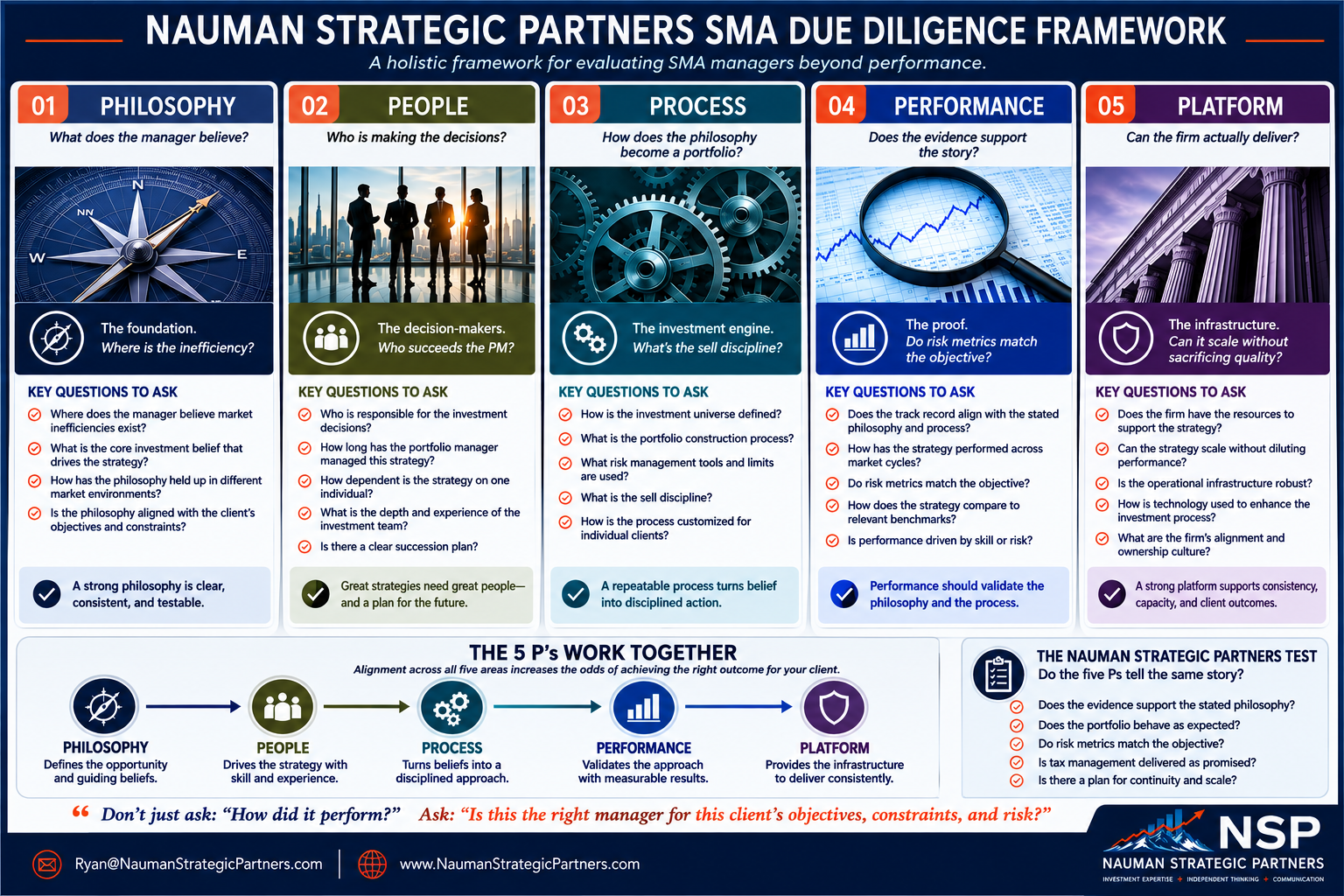
Selecting the right separately managed account manager requires more than reviewing a performance chart. This framework guides financial advisors through a structured evaluation of five critical dimensions of any SMA manager — Philosophy, People, Process, Performance, and Platform — ensuring that every recommendation is grounded in rigorous analysis and aligned with each client’s specific objectives and risk tolerance.
Have you evaluated the manager across the 5 Ps?
TAKE THE FRAMEWORK WITH YOU
Download the Nauman Strategic Partners SMA Manager Due Diligence Toolkit
A practical seven-page resource designed to help financial advisors evaluate SMA managers across Philosophy, People, Process, Performance, and Platform.
Inside you’ll find:
Section 1: SMA Due Diligence Framework
Section 2: Philosophy
Section 3: People
Section 4: Process
Section 5: Performance
Section 6: Platform
Section 7: The Nauman Strategic Partners Final Cheat Sheet
01 — Philosophy
What does the manager believe?
Where does the manager believe market inefficiencies exist?
Is the investment philosophy clear and repeatable?
Does it remain consistent when the strategy falls out of favor?
02 — People
Who is actually making the decisions?
How experienced is the portfolio manager?
Is the strategy dependent on one individual?
How deep is the investment team? Is there a succession plan?
03 — Process
How does the philosophy become a portfolio?
How are investments selected, sized, monitored, and sold?
How does the manager manage risk?
Can the process accommodate the customization and tax-management capabilities that make SMAs attractive?
04 — Performance
Does the evidence support the story?
Performance should be evaluated in the context of risk.
Do drawdowns, downside capture, tracking error, and other analytics align with the stated objective?
Does the strategy behave the way you would expect?
05 — Platform
Can the firm actually deliver?
Is the firm committed to the SMA business?
Does it have the people, technology, trading capabilities, tax-management infrastructure, and client-service resources necessary to deliver the strategy?
And can it scale without sacrificing quality?
The Nauman Strategic Partners Test
Do the five Ps tell the same story?
If the manager says the strategy is defensive, does the performance support that?
If the strategy is actively managed, does the portfolio actually demonstrate meaningful active characteristics?
If tax management is a key differentiator, can the manager demonstrate how that capability is delivered?
If the strategy relies heavily on one portfolio manager, is there a credible succession plan?
The philosophy, people, process, performance, and platform should align.
Don’t just ask: “How did it perform?”
Ask: “Is this the right manager for this client’s objective, constraints, and risk?”

