
Part 2 of the Nauman Strategic Partners SMA Manager Due Diligence Framework
Last week, we started our deeper dive into the Nauman Strategic Partners SMA Manager Due Diligence Framework with Philosophy, understanding what a manager believes and whether those beliefs are reflected in the portfolio.
Learn more about Nauman Strategic Partner’s SMA due diligence framework here.
This week, we move to the second P: People.
Investment strategies are often presented as products. They have names, fact sheets, performance histories, Morningstar categories, benchmarks and investment objectives.
But an SMA isn’t really a product sitting on a shelf.
There are people behind it making decisions with your client’s money.
They’re deciding what to buy. What to sell. How much risk to take. When to deviate from a benchmark. And how to respond when markets don’t behave as expected.
That’s why understanding the people behind the strategy should be a critical part of manager due diligence.
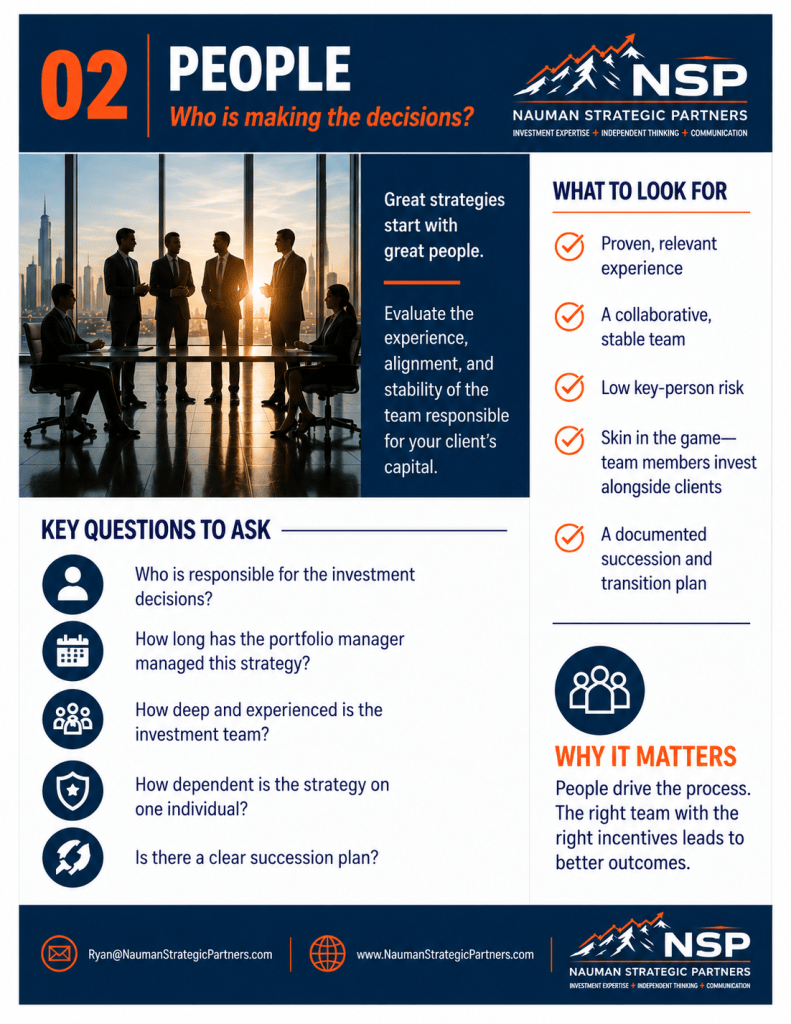
Why People Matter
A great investment philosophy is only as valuable as the people responsible for executing it.
When an advisor selects an SMA manager, they aren’t simply buying a historical track record. They’re placing confidence in the investment professionals responsible for producing the next five or ten years of results.
Historical performance may have been generated by a portfolio manager who is no longer at the firm. A strategy may have benefited from analysts who have since departed. The firm’s research resources may have changed significantly as assets have grown.
The name of the strategy might be the same. The people responsible for producing the results might not be.
That’s why due diligence needs to go beyond asking who the lead portfolio manager is. Advisors should understand the entire investment team, how decisions are made, whether the team has the appropriate experience and resources, and what happens if an important person leaves.
Key Questions to Ask
- Who is actually responsible for making the investment decisions?
- How long has the portfolio manager managed this strategy?
- Is the strategy managed by an individual or a team?
- How experienced and deep is the investment team?
- Who are the key analysts and other investment professionals supporting the strategy?
- How dependent is the strategy on one individual?
- Has there been meaningful turnover on the investment team?
- Is the team adequately staffed given the strategy’s current assets under management?
- Can the existing team support significant future asset growth?
- Is there a documented succession plan?
The answers can tell you a lot more than simply reading the portfolio manager’s biography.
What to Look For
Experience matters, but I wouldn’t evaluate experience simply by counting years in the industry. I want to understand whether the team’s experience is relevant to the strategy they’re managing.
Has the portfolio manager managed money through different market and economic cycles? Have they experienced periods when their investment style was deeply out of favor? How did they respond?
For specialized strategies, expertise becomes even more important. If an SMA emphasizes tax management, sustainable investing, concentrated-stock management or another specialized capability, does the team actually have experience delivering it?
I’d also look closely at team stability. A collaborative investment team that has worked together for years may provide greater continuity than a strategy heavily dependent on a single star portfolio manager.
And incentives matter. Do the portfolio managers invest alongside clients? Is compensation structured to encourage long-term decision-making? Are key investment professionals incentivized to remain with the firm?
You’re trying to understand not just who is on the team today, but whether the structure exists to keep the right people making good decisions on behalf of clients tomorrow.
Red Flags: When the People Story Doesn’t Add Up
One of the biggest risks is key-person dependency.
If nearly every important investment decision ultimately comes back to one portfolio manager, advisors should understand what happens if that individual retires, leaves the firm or simply isn’t available.
A strong historical track record doesn’t eliminate that risk. In fact, the longer and more successful the track record, the more important it can become to understand who actually created it.
- Significant or repeated turnover among portfolio managers or research analysts.
- A strategy marketed around a well-known portfolio manager who has limited involvement in day-to-day decisions.
- A team that appears understaffed relative to the strategy’s assets or complexity.
- Rapid AUM growth without corresponding investment in research, trading or portfolio-management resources.
- Unclear decision-making authority within a supposedly team-managed strategy.
- Compensation or ownership structures that could make it difficult to retain key professionals.
- No credible succession plan for a long-tenured or dominant portfolio manager.
They’re signals to ask another question.
For example, turnover isn’t always bad. A firm may have intentionally strengthened its investment team. A new portfolio manager may bring valuable expertise. But the manager should be able to explain what changed, why it changed and how those changes affect the strategy going forward.
Don’t Confuse the Track Record With the Team
This is where People connects directly with Performance.
Imagine evaluating a strategy with an impressive ten-year track record. That’s useful information. But what if the current portfolio manager has only been running the strategy for 18 months? Or several analysts responsible for generating the ideas behind that historical performance have left?
The historical performance hasn’t changed. But your interpretation of it probably should.
Advisors need to determine whether the people currently managing the strategy are the same people—or possess the same capabilities and resources, that generated the results they’re evaluating. That is a very different question from simply asking whether the strategy has outperformed its benchmark.
The People Test
For me, the second P ultimately comes down to this:
Do I have confidence in the people who will be making decisions with my client’s capital going forward?
That requires more than an impressive résumé. I want relevant experience. A stable and appropriately resourced team. Clear decision-making responsibilities. Aligned incentives. Low or manageable key-person risk. And a credible plan for succession and continuity.
Because advisors aren’t investing in a fact sheet, a Morningstar category or a historical track record. They’re investing in the people responsible for what happens next.
That’s why People is the second P in the Nauman Strategic Partners SMA Manager Due Diligence Framework.
Next in the series: Process — How does the philosophy actually become a portfolio?


Leave a Reply