
Part 1 of the Nauman Strategic Partners SMA Manager Due Diligence Framework
Last week, I introduced the Nauman Strategic Partners SMA Manager Due Diligence Framework, built around five areas I believe financial advisors should evaluate when selecting a separately managed account manager:
Philosophy. People. Process. Performance. Platform.
Over the next several weeks, I want to take a deeper look at each of the five Ps, beginning with the foundation: Philosophy.
When evaluating an investment manager, performance tends to get most of the attention. That’s understandable. Ultimately, advisors hire investment managers to deliver results for their clients.
But before asking how a strategy performed, I think there’s another important question:
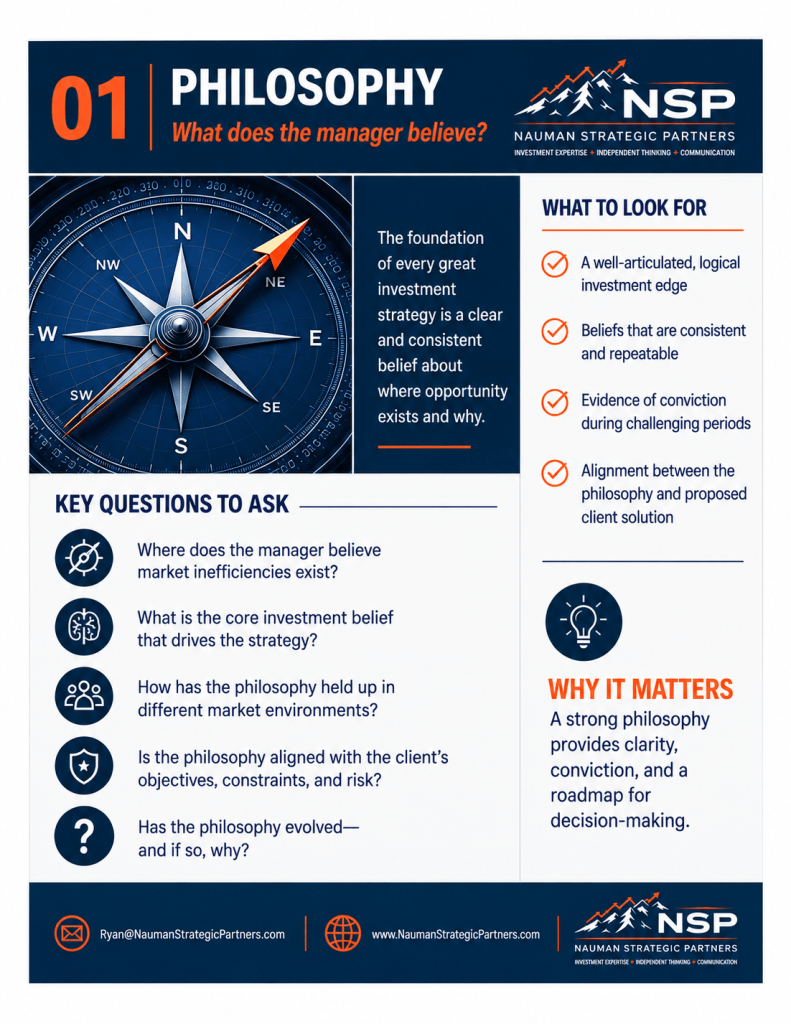
What does this manager actually believe?
Philosophy tells you where the manager believes the opportunity exists
Every investment strategy should be built around a core set of beliefs.
Perhaps the manager believes markets systematically misprice certain securities. Maybe the edge comes from fundamental research, behavioral biases, quality, valuation, income, or identifying long-term secular trends.
Whatever the answer, an advisor should be able to understand where the manager believes an inefficiency or opportunity exists—and why the manager believes they can exploit it.
A strong investment philosophy should provide the foundation for how the portfolio is built and managed.
But understanding the philosophy is only the beginning. The more important part of due diligence is determining whether that philosophy is clear, consistent and actually reflected in the portfolio.
Key questions to ask
- Where does the manager believe market inefficiencies exist?
- What is the core investment belief that drives the strategy?
- How has that philosophy held up across different market environments?
- Is the philosophy aligned with the client’s objectives, constraints and risk tolerance?
- Do the actual portfolio holdings reflect the stated philosophy?
- Has the philosophy evolved over time—and if so, why?
That last question can be particularly revealing. Investment strategies shouldn’t be frozen in time. Markets evolve. Technology changes. New information becomes available. A thoughtful manager should continue learning.
But there is an important distinction between evolving a philosophy and abandoning it when it becomes uncomfortable.
What to look for
I want to hear a philosophy that is understandable and defensible.
The manager should be able to clearly articulate the investment edge without relying on jargon or a rehearsed marketing pitch. More importantly, there should be evidence that the manager has remained committed to those beliefs through different market environments.
That becomes especially important when the manager’s investment style falls out of favor.
If a value manager suddenly begins chasing high-growth momentum stocks because growth is leading the market, that’s worth investigating. If a manager who emphasizes downside protection suddenly takes significantly more risk to keep pace with a rising market, advisors should understand why.
Periods of underperformance can actually provide some of the most valuable information during manager due diligence.
What did the manager do when their philosophy was tested?
Did they remain disciplined? Did they make reasonable refinements? Or did they change direction because the strategy was no longer working in the current environment?
Red flags: Watch for the disconnects
One of the biggest red flags isn’t necessarily poor performance. It’s inconsistency.
A manager may tell a compelling story, but the portfolio and performance should provide evidence that the story is true.
- A philosophy that changes materially with market conditions or recent performance.
- Holdings that do not reflect the manager’s stated investment approach.
- Unexplained style drift or portfolio changes that contradict the stated philosophy.
- Risk characteristics that conflict with the strategy’s stated objective.
- A manager who cannot clearly explain why the philosophy should continue to work.
For example, if a manager describes a strategy as defensive, but it consistently captures most or all of the downside during market declines, that’s worth exploring.
Similarly, if a manager claims to be a high-conviction active investor but the portfolio behaves very similarly to its benchmark, an advisor should understand why.
None of these observations automatically make a manager unsuitable.
They are signals to ask another question.
And that’s really what good due diligence is about.
The Philosophy Test
At Nauman Strategic Partners, I think the first P ultimately comes down to a relatively simple test:
Does what the manager says they believe match what they actually do?
The philosophy should show up in the process.
It should show up in the holdings.
It should show up in the risk profile.
And, over a sufficiently meaningful period, it should help explain the strategy’s performance.
That’s why Philosophy is the first of the five Ps. It establishes the investment thesis that everything else in the due-diligence process should either validate—or challenge.
Next in the series: People — Who is actually making the investment decisions?


Leave a Reply