
The Federal Reserve raised its benchmark rate by 25 basis points to a target range of 3.75% to 4.00%, its first increase since 2023. The move itself was widely anticipated. The more consequential message came from the projections: most policymakers expect at least one additional increase in 2026, pushing back against the market’s one-and-done assumption and reinforcing a higher-for-longer interest-rate environment.
Markets did not treat that message gently. Stocks reversed earlier gains, economically sensitive shares lagged, and the 10-year Treasury yield finished above 5%. Yet the decision also delivered something the bond market needed: evidence that the Fed is prepared to defend price stability even when doing so is politically uncomfortable.
Market reaction
NSP Market Dashboard
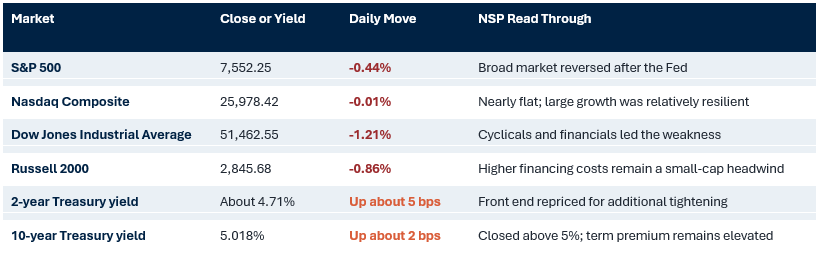
Data timing: equity indexes at the September 16 close; Treasury yields near the end of the cash session. Yield changes are approximate because Treasury trading continues after the stock-market close.
The hike was supported by the data
The Fed did not tighten into a collapsing economy. August retail sales rose 1.2%, and the control group used in GDP calculations increased 1.4%. At the same time, import prices rose 0.7% during the month and 7.0% from a year earlier. Strong demand gives businesses room to pass through higher costs and gives the Fed more room to respond without immediately threatening the expansion.
That combination matters. Consumer resilience is supportive for revenue and corporate earnings, but it also limits the disinflationary help the Fed can expect from weaker demand. Rising input costs, elevated energy prices and broad import inflation increase the risk that price pressures remain persistent rather than temporary.
Warsh chose credibility over convenience
“The plain fact is that inflation is too high, and has been for too long. This summer’s inflation readings do not tell me that underlying trends have meaningfully improved.”
— Federal Reserve Chair Kevin Warsh
Those words were backed by action. The unanimous decision strengthened the Fed’s inflation-fighting credibility and demonstrated operational independence from the White House, which had pushed for lower rates. One decision cannot settle every question about institutional independence, but raising rates despite that pressure is meaningful evidence that the central bank remains focused on its mandate.
Credibility matters beyond the overnight policy rate. If investors believe the Fed will keep inflation expectations anchored, the risk premium embedded in longer-term bonds can eventually decline. That is the constructive part of today’s decision for duration. It is also why a rate hike can, under the right circumstances, prevent long-term borrowing costs from rising even more.
Higher for longer replaces one and done
The dot plot did not validate the one-and-done thesis. Sixteen of eighteen policymakers projected at least one more increase this year, and the median projection placed the federal funds rate at 4.00% to 4.25% at year-end. The median then held that level through 2027. The Fed also raised its 2026 inflation projection and pushed the expected return to 2% into 2029.
The dots are not promises, and Warsh emphasized that future decisions will depend on incoming evidence. Still, the direction is clear: policymakers believe today’s hike may not be enough. Investors should therefore distinguish between a credible Fed and an easy bond-market backdrop. Credibility provides some relief for longer duration; another projected hike, persistent inflation, heavy Treasury issuance and elevated term premiums mean it is not an all-clear.
What it means for portfolios and advisors
Short-duration bonds. The front end remains attractive because yields provide meaningful income with less sensitivity to additional rate increases. If the Fed follows the projected path, short maturities can continue to benefit from elevated policy rates while limiting mark-to-market volatility.
Longer-duration bonds. The case has improved at the margin because the Fed reinforced its credibility, but longer maturities remain exposed to inflation surprises, Treasury supply and term-premium volatility. Duration can still play an important diversification role, particularly if growth weakens, but today’s meeting argues for measured exposure rather than an indiscriminate extension.
Equities. Strong consumer spending and earnings remain important supports. However, a higher-for-longer rate path raises the discount rate applied to future cash flows and increases financing costs. Small caps, housing, leveraged companies and long-duration growth stocks face the greatest pressure. Large, profitable businesses with strong balance sheets and pricing power are better positioned to absorb the change.
A strategy to consider: Bond ladders
A bond ladder can help investors navigate an environment in which current yields are attractive but the path of rates remains uncertain. The strategy divides a fixed-income allocation among bonds that mature at regular intervals, for example, annually across one to five years, instead of making one large maturity or duration decision.
As each rung matures, proceeds can be reinvested at prevailing yields or used for portfolio cash needs. If rates rise, maturing principal can be rolled into higher-yielding securities. If rates fall, the longer rungs preserve yields that were locked in earlier. The result is not protection from every loss, and credit quality, liquidity, taxes and reinvestment risk still matter. But a ladder can turn rate uncertainty into a disciplined reinvestment process rather than a prediction contest.
Perspective matters more than prediction
The Fed’s decision is consequential, but it is still one step in a much longer market and economic journey. Advisors should reassess whether portfolio duration, liquidity and equity risk remain aligned with client objectives—not assume that one meeting requires wholesale change.
Markets will continue to debate whether the next hike arrives, when inflation improves and where the 10-year Treasury yield ultimately settles. Client goals, time horizons and risk tolerances usually change much more slowly. Staying anchored to those objectives, while making measured adjustments when the evidence changes, remains more durable than reacting dramatically to a single policy event.
Sources
• Federal Reserve FOMC calendar, statement and projection materials
• Reuters coverage of the decision, projections and market reaction
• Reuters coverage of August retail sales and import prices
• Axios summary of the press conference and projections
Important disclosure
This material is for informational and educational purposes only and does not constitute individualized investment, tax or legal advice. Market data may be revised. All investments involve risk, including possible loss of principal.


Leave a Reply